

Two-Thirds Don't Play
What the golf-course view is actually paying for — and what happens when you swap the course for a farm.
Roughly two-thirds of the people who live on a golf-course community never play the course.
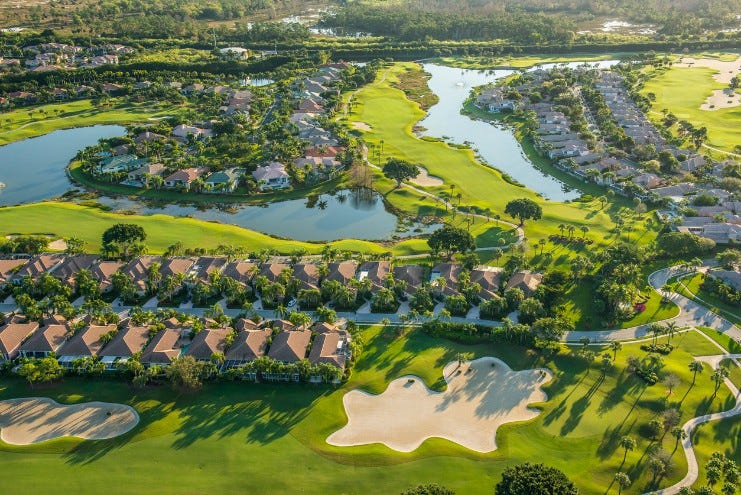
That number turns up in the valuation research, and once you sit with it, a lot of conventional development logic starts to look like a rounding error. The frontage premium on a golf-course home runs somewhere in the fifteen-to-thirty-percent range, with homes merely adjacent to the fairway still picking up eight to twelve. Developers have spent decades booking that as a golf premium. It isn’t. Two-thirds of the buyers don’t golf. They’re paying for the unbroken green out the back door, the mature canopy, the quiet streets, the absence of a neighbor’s wall where a view should be. They’re paying for managed open space. The course is the delivery mechanism, not the product.
And it’s an expensive mechanism. A golf course is a year-round irrigation, fertilizer, and maintenance obligation that the residents fund through HOA dues and, two times out of three, never set foot on. It throws off no revenue. It sequesters no carbon worth counting. It is, for most of the people paying for it, a very costly lawn.
So the question that reorganized our project in the Catskills was a simple one. If the amenity people actually value is managed green space — not golf specifically — what else could occupy that role?
The Urban Land Institute has been documenting the answer for years. Its research on agrihoods finds the same fifteen-to-thirty-percent adjacency premium for homes near parks, open space, and working farms that the golf studies find for fairway frontage. Same premium. The model has been built out across roughly two hundred agrihood projects in more than thirty states — Hillwood’s Harvest outside Dallas, the Cannery in Davis, Serenbe outside Atlanta — and the strongest of them top their regional sales rankings. The buyer is paying for the same thing either way: the green view, the walkable landscape, the quiet. A farm delivers it.
But a farm delivers three things the course does not.
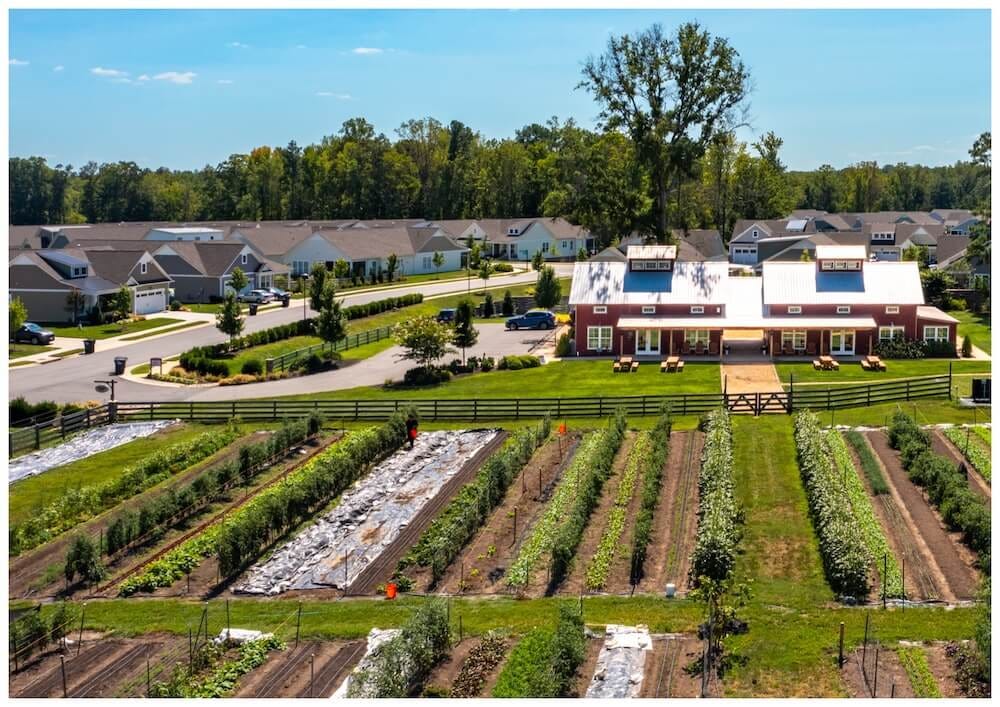
It throws off an operating revenue stream — the course is a cost center; the farm is a business. It builds an ecological performance record the project can measure and underwrite against — soil that holds moisture, a foodshed contribution, carbon in the ground. And it offers an experience a growing share of buyers now actively prefer over a fairway they’ll never walk.
That was already enough to move the plan. Then we looked at the water.
The single largest physical problem on the parcel was stormwater. Decades of agricultural neglect had left the soils compacted, the absorption poor, the ground chronically wet — the sort of condition a conventional approach solves with gray infrastructure: concrete drainage, engineered retention, hardscape. The regenerative path solved it differently. The same agroforestry plantings we’d added for the amenity and the revenue would, as they matured, drive deep roots into the compacted soil and open absorption the concrete could only approximate. The wet ground got drier year over year as the plantings established. We didn’t build the drainage system. The landscape was the drainage system.
Count the jobs one decision did. The plantings satisfied the conservation requirement. They generated the agricultural economics. They created the community amenity that carries the pricing premium. They solved the hydrology. One move, four returns — and each one measurable.
That’s the part conventional underwriting misses. Treated as decoration, a landscape is a cost line that never comes back. Treated as infrastructure, it does work the project would otherwise capitalize in concrete — and it keeps doing that work, and improving at it, across the entire hold. A wetland that handles retention displaces a detention vault. A canopy that cools a courtyard cuts the cooling load on the buildings around it. Deep roots on a slope do the job of a retaining wall. The capital you don’t spend is real. The operating savings compound.
Here’s the line I keep coming back to. For most of the last twenty years, the industry treated environmental performance and financial return as a tradeoff — pick one, pay for the other. That was true when the tools were primitive and the premium was real. It is not true now. The soil data is measurable. The performance is financeable. The premium on doing it well has compressed to within striking distance of conventional, and the value of the resilience has gone up as the climate has made resilience scarce.
The conservation goal and the economic goal stopped being in tension on that parcel. They turned out to be the same plan. The only thing standing between most operators and that result is the willingness to see the green amenity for what the buyer was always paying for — and to use the tools well enough to make it perform.
I work with developers and operators on regenerative underwriting and project structuring through my consulting practice — reach out if it’s something you’re thinking about.
This post is drawn from Ground Truth, my book on how technology, capital, and climate are rewiring commercial real estate. Available on Amazon. Audio
If you’d like more of this, subscribe — new posts every other week.